

Powder-Coated Aluminum
Aluminum Deck Railing Kits and Systems
- Square baluster, horizontal rod and more
- Textured, matte, satin and coastal finishes
- Pre-engineered and third-party evaluated

Aluminum is the low-maintenance railing that does not rot or rust. The rest is yours to choose: the style, the finish, the color, and whether it reads sleek or traditional.
Sort
Choose a Collection


![2-1/2\" Surface Mount Aluminum Deck Post [FLORIDA ONLY] in textured black](http://insosupply.com/cdn/shop/products/keylink-aluminum-post-textured-black-38-keylink-2-1-2-surface-mount-aluminum-deck-post-1170796805.jpg?v=1748642410&width=1600)
![2-1/2\" Surface Mount Aluminum Deck Post [FLORIDA ONLY]](http://insosupply.com/cdn/shop/products/keylink-aluminum-post-keylink-2-1-2-surface-mount-aluminum-deck-post-1170796804.jpg?v=1750085302&width=1600)


![Keylink Flat Post Cap [FLORIDA ONLY] in textured black - deck post cap](http://insosupply.com/cdn/shop/products/keylink-post-cap-textured-black-2-1-2-keylink-flat-post-cap-1170796800.jpg?v=1748642177&width=1600)
![Keylink Flat Post Cap [FLORIDA ONLY]](http://insosupply.com/cdn/shop/products/keylink-post-cap-keylink-flat-post-cap-1170796801.jpg?v=1750085302&width=1600)
![American Series Additional Bracket Kit Coastal Finishes [FLORIDA ONLY] in textured black - railing bracket](http://insosupply.com/cdn/shop/products/keylink-american-series-bracket-textured-black-2-pack-level-bracket-keylink-american-series-additional-bracket-kit-1170796794.jpg?v=1748642059&width=1600)
![American Series Additional Bracket Kit Coastal Finishes [FLORIDA ONLY] in textured black](http://insosupply.com/cdn/shop/files/keylink-american-series-bracket-textured-black-2-pack-stair-bracket-32-36-keylink-american-series-additional-bracket-kit-1170796790.jpg?v=1748642047&width=1600)


How do you choose aluminum deck railing?
Start with where it comes from. There are a lot of aluminum railing brands, and two things are worth settling before you look at a single photo: whether the system has a third-party code evaluation, and whether the company behind the warranty will still be there to honor it. If the brand isn't around in ten years, the warranty isn't either.
After that it is a style choice. Traditional or modern, a standard powder coat or a coastal finish if you are near salt water, and then the four decisions below: infill, top rail, mount and height.
Square baluster or horizontal rod?
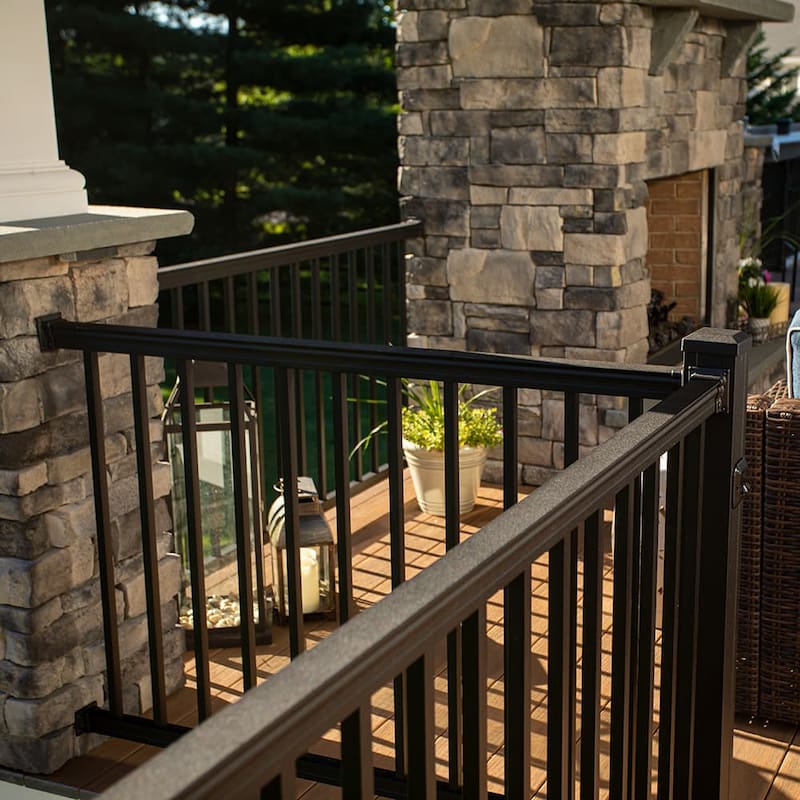
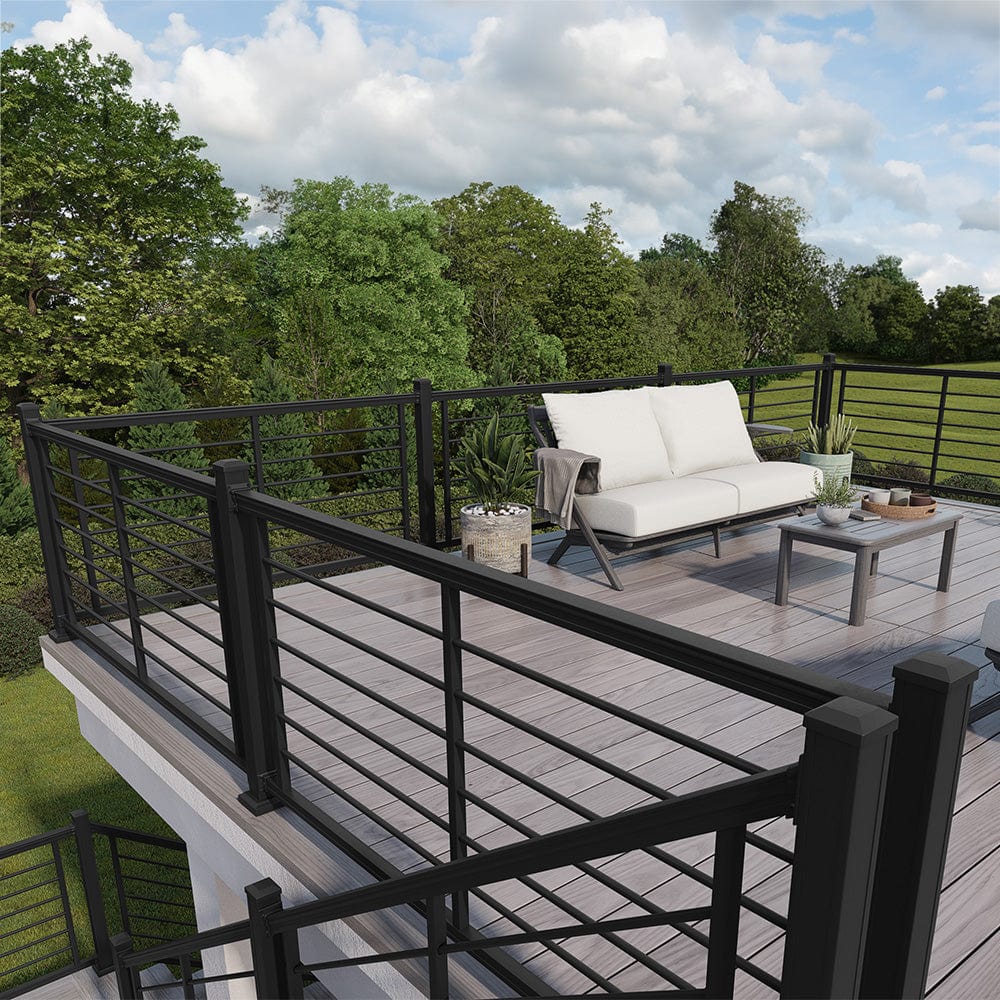
Square baluster is the common choice and it reads traditional. Rod rail runs horizontal aluminum rods between the rails instead of pickets and reads modern: all aluminum, nothing to tension, and a different look rather than a bigger opening. Infill is the term for whatever fills the space between the posts, and a baluster is a vertical picket. Square balusters are usually 3/4 inch, and a slimmer 5/8 inch baluster puts less metal in each opening.
Round, twisted and bowed balusters are available on some series, as is a third rail that breaks the panel horizontally. If the view is the point of the deck, vertical cable runs on these same posts, and horizontal cable uses posts drilled for it.
Standard top rail or drink rail?
Aluminum railing comes two ways at the top. A standard aluminum top rail is a flat or profiled rail, usually somewhere between 1-5/8 and 1-3/4 inches wide. A drink rail is a top rail shaped to carry a deck board or an aluminum flat cap, so the top of the railing doubles as a ledge you can set something on.
Most of the brands we carry offer both, at more than one price point. Within a brand family the two usually share posts and colors, so you can run a drink rail on the section facing the yard and a standard rail everywhere else and have it match.
Surface mount or fascia mount?
If price is the deciding factor, surface mount is generally the lower-cost way to do it. The post sets on top of the deck boards with a welded base plate, and it is the default on every system here.
Fascia mount hangs the post off the rim joist, the board around the outside of the deck, which frees up deck space. When you consider what a square foot of deck costs to build, it is almost like getting free square footage. Posts come in 2-1/2 inch and 3-1/4 inch in both mounts. A line post sits mid-run, a corner post turns the run, and an end post finishes it at a wall or the top of a stair. Your layout marks which is which, so the parts list has the right count. The fascia mount collection has the fascia posts and brackets.
Height: 36 or 42 inch
Every system here comes in 36 and 42 inch. A guard is required where the deck is more than 30 inches above grade (2024 IRC R321.1.1, which was R312.1.1 in the 2021 edition). A residential deck guard must be at least 36 inches (R321.1.2), and openings may not pass a 4 inch sphere (R321.1.3). On a stair the guard is measured from a line connecting the tread nosings, and the code minimum there is 34 inches. The 42 inch height is for jobs whose code or specifier calls for it. The wording did not change between editions, only the section numbers, so check which edition your jurisdiction has adopted and confirm the height with your building department.
What colors does aluminum railing come in?
Black, bronze and white are the colors most people come for, and the standard palette runs to six: Textured Black, Textured Bronze, Matte White, Matte Black, Oil Rubbed Bronze and Textured White. Satin colors are available on some series, and one series comes as white rails with black balusters.
Coastal finishes are a separate upgrade for salt air, on rails, posts, caps and trim. The powder coat is applied at the factory to an AAMA 2604 finish, which is a coating standard rather than a paint color. Color samples cover the six standard colors.
What comes in an aluminum railing kit?
One kit is one section: top and bottom rail, balusters, mounting brackets and hardware. Eight foot sections add a foot block for surface mount, and the fascia mount section support is a separate part.
Posts, post caps, post trim and gates are priced separately, per post, on top of the sections. That is the part most people miss when they compare a kit price to a quote. A specialist builds your layout, walks you through it, and quotes it in one business day. You approve the layout, and the parts list comes off it. Get My Free Design.
Can you use aluminum railing on stairs?
Yes. Stairs use the same system as the level runs. Kits come in stair sections cut to follow the pitch of the stringer, the sloped board the treads sit on, and the fascia mount post comes in a stair version so the railing can hang off the side of the stringer instead of sitting on the treads.
Two things change on a stair. The guard height is measured vertically from the tread nosing rather than from a walking surface, and many residential codes accept 34 inches there. And the openings allowance is different: on the open side of a stair a 4-3/8 inch sphere is permitted, plus a 6 inch sphere in the triangle between the riser, the tread and the bottom rail. Send us the rise and run and the stair sections come off it.
Does aluminum railing work on a porch?
Yes, and it is the easiest version of this. The same surface mount posts, sections and colors that go on a deck go on a porch, and the base plate anchors to wood framing or to concrete with the appropriate anchors for each. Column spacing usually sets the section lengths rather than the other way around, so a porch often takes more of the shorter sections and fewer 8 foot ones.
Height rules follow the same trigger as a deck: a guard is required where the walking surface is more than 30 inches above what is below it. Our guide to aluminum railing on wood or concrete covers the anchoring for each surface.
Do you need a handrail as well as the railing?
They are two different things and a stair often needs both. A guard is the barrier that keeps people from falling off the edge. A handrail is the graspable rail you actually hold on the way down, and under the IRC (R311.7.8) a stair with four or more risers needs one on at least one side, 34 to 38 inches above the tread nosings.
The railing itself does not satisfy that on its own, because a top rail wide enough to be a drink rail is not graspable. Both brands we carry offer an ADA handrail for exactly this, mounted to the posts or the wall. If your stair needs one, say so on the quote and it comes in the layout.
Which brand do we recommend?
Keylink, for most customers. In our opinion it is the highest quality of the aluminum systems we have handled, with the best warranty and the most customization: the widest color range, textured, matte, satin and coastal finishes, and surface or fascia mount across the line. It is made in New Holland, Pennsylvania, and we have sold it, supplied it, and seen what comes back.
That is not the answer for everyone. There are styles and price points where Keylink is not the fit, and we carry other brands for those. If you are weighing options, ask. We are happy to go through the brands and find the one that works for your project, and nobody pays us to recommend a system.
Our Railworthy Standard
We only sell railing that is third-party evaluated, from brands with years in service. A system that misses either one does not get quoted here, no matter the margin.
Compare the aluminum railing systems
| Keylink American | Keylink Chesapeake | Keylink Outlook | |
|---|---|---|---|
| Top rail | Standard flat rail, 1-3/4 in wide | Drink rail, takes a deck board or 3-1/2 in flat cap (sold separately) | Standard profiled rail, 1-5/8 in wide |
| Infill options | 3/4 in square baluster, or horizontal rod | 3/4 in square baluster, or horizontal rod | 5/8 in square baluster |
| Heights | 36 and 42 in | 36 and 42 in | 36 and 42 in |
| Section lengths | 6 and 8 ft | 6 and 8 ft | 4, 5, 6 and 8 ft |
| Posts | 2-1/2 or 3-1/4 in aluminum, surface or fascia mount | 2-1/2 or 3-1/4 in aluminum, surface or fascia mount; 2-1/2 in posts take reducer brackets | 2-1/2 or 3-1/4 in aluminum, surface or fascia mount |
| Gates | Square baluster gate, 36 or 48 in wide | None in this collection | Adjustable gate, 36 or 48 in wide |
| Colors | Six standard colors, Satin and Coastal finishes, white rails with black balusters | Six standard colors, Satin and Coastal finishes | Six standard colors, Coastal finishes |
Frequently asked questions
What is the best aluminum deck railing?
The one whose infill and top rail match what you want, from a brand that will still be there when you need the warranty. Our pick for most customers is Keylink, for the quality, the warranty and the range of colors and finishes. Where it is not the fit, we carry other brands, and we will go through them with you rather than steer you.
Is metal deck railing the same as aluminum deck railing?
Usually, yes. When people search for metal deck railing they almost always mean aluminum, because it is the metal that does not rust and does not need refinishing on a deck. Steel and wrought iron are also metal railings, but they are heavier and they corrode where the coating is broken. Everything on this page is aluminum.
Does aluminum deck railing rust?
No. Rust is iron oxide. Aluminum forms its own oxide skin instead, and it does not rust. The powder coat goes on to an AAMA 2604 finish. For salt air, the Coastal finishes are a separate upgrade on rails, posts, caps and trim in Textured Black, Textured Bronze and White.
What is the difference between a standard top rail and a drink rail?
A standard top rail is a flat or profiled aluminum rail, roughly 1-5/8 to 1-3/4 inches wide, and it is what most people picture. A drink rail is shaped as a channel that carries a deck board or an aluminum flat cap, so the top becomes a ledge. Most customers who choose a drink rail use their own decking so the cap matches the deck.
How tall does aluminum deck railing need to be?
At least 36 inches on a residential deck (2024 IRC R321.1.2, which was R312.1.2 in the 2021 edition), with openings that will not pass a 4 inch sphere (R321.1.3). On the open side of a stair the guard is measured from a line connecting the tread nosings and may be 34 inches. Every system here comes in both heights. Confirm with your building department before you order.
Do aluminum railing kits include the posts?
No. A kit is one rail section with its balusters, brackets and hardware. Posts, post caps and post trim are separate parts, because the post depends on your mount type and height: 2-1/2 inch or 3-1/4 inch surface mount posts, or fascia mount posts in level and stair versions for 36 and 42 inch railing.
Which aluminum railing has the most open view?
The one with the slimmest baluster and the slimmest rail, which here is the 5/8 inch square baluster rather than the 3/4 inch. Rod rail is a different look, horizontal lines instead of pickets, not a bigger opening. If the view is the whole point, cable railing is the next step, and vertical cable runs on these same posts.
Can aluminum railing be used on a porch or over concrete?
Yes. The surface mount posts have a welded base plate with a leveling plate and set screws, and the plate anchors to wood framing or to concrete with the appropriate anchors for each. Porch railing uses the same sections, posts and colors as a deck.
Related collections and products
- Cable Railing Kits for Stairs, Decks and Interiors
- Frameless Glass Deck Railing Panels and Spigots
- Keylink Aluminum Rod Rail Collection
- Fascia Mount Deck Railing Posts and Kits
- Keylink American Series Aluminum Railing Kit
- Keylink Chesapeake Series Square Baluster Railing
- Keylink Outlook Series Aluminum Deck Railing Kit
- Keylink 2-1/2" Surface Mount Aluminum Deck Post
Ready to see it on your deck?
You approve the layout, and the parts list comes off it. A specialist quotes it in one business day.
Get My Free Design