
Keylink Railing Logo

Fascia Mount Deck Railing Collection

36 products
Keylink Vertical Cable Rail Keylink American Series Vertical Cable Railing System 122111366-11, 122112366-11, 122111368-11, 122112368-11, 122111366-13, 122112366-13, 122111368-13, 122112368-13
Keylink Vertical Cable Rail Textured Black / 36" / 8' Level (93") Keylink American Series Vertical Cable Railing System 122111366-11, 122112366-11, 122111368-11, 122112368-11, 122111366-13, 122112366-13, 122111368-13, 122112368-13
Textured Black Textured Bronze Matte White Matte Black +9
Keylink American Series Vertical Cable Railing Kit
from $427.25
Keylink American Square Baluster Textured Black / 36" / 6' Level Keylink American Series Aluminum Railing Kit
Keylink American Square Baluster Textured Black / 42" / 8'Level Keylink American Series Aluminum Railing Kit
Textured Black Textured Bronze Matte White Matte Black +10
Keylink American Series Aluminum Railing Kit
from $289.94
Keylink American Series Bracket Textured Black / 2 Pack / Level Bracket Keylink American Series Additional Bracket Kit
Keylink American Series Bracket Textured Black / 2 Pack / Stair Bracket (32°-36°) Keylink American Series Additional Bracket Kit
Textured Black Textured Bronze Matte White Matte Black +9
Keylink American Series Additional Bracket Kit
from $28.86
Keylink Stainless Steel Cable Stainless Steel / 100' Keylink Stainless Steel Cable for Railing
Keylink Stainless Steel Cable Matte Black / 100' Keylink Stainless Steel Cable for Railing
Stainless Steel Matte Black
Keylink Stainless Steel Cable for Railing
from $132.27
Keylink Post Cap Textured Black / 2-1/2" Keylink Flat Post Cap
Keylink Post Cap Keylink Flat Post Cap
Textured Black Textured Bronze Matte White Matte Black +9
Keylink Flat Post Cap
from $8.29
Keylink Tools Keylink Gripping Pliers for 1/8" Cable
Keylink Gripping Pliers for 1/8" Cable
$93.85
Keylink Tools Tension Gauge for 1/8" Cable
Tension Gauge for 1/8" Cable
$284.74
Keylink Tools Keylink Cable Release Tool
Keylink Cable Release Tool
$8.30
Keylink Keylink Color Samples
Keylink Color Samples
$5.00
Keylink Cable Railing Posts - Fascia Mount Keylink Fascia Mount Post for 36" Horizontal Cable
Textured Black Textured Bronze Matte White Matte Black +9
Keylink Fascia Mount Post for 36" Horizontal Cable
from $135.31
Keylink Tools Keylink Cable Threading Needle
Keylink Cable Threading Needle
$8.38
Keylink Tools Keylink Grip Adapters for 10R Vice Grips
Keylink Grip Adapters for 10R Vice Grips
$19.23
Keylink Keylink Fascia Mounted Section Support Assembly for 8' Railing Kits
Textured Black Textured Bronze Matte White Matte Black +2
Keylink Fascia Mounted Section Support Assembly for 8' Railing Kits
$53.68
Keylink Gate Keylink American Series Vertical Cable Adjustible Gate
Textured Black Textured Bronze Textured White Matte Black +5
Keylink American Series Vertical Cable Adjustible Gate
from $420.98
Keylink Cable Railing Posts - Fascia Mount Keylink Fascia Mount Post for 42" Horizontal Cable
Textured Black Textured Bronze Matte White Matte Black +9
Keylink Fascia Mount Post for 42" Horizontal Cable
from $147.15
Keylink Keylink Fascia Mount Post Brackets
Textured Black Matte White Textured Bronze Matte Black +9
Keylink Fascia Mount Post Brackets
from $110.65
Keylink Aluminum Post Keylink Fascia Mount Deck Rail Post
Textured Black Textured Bronze Matte White Matte Black +9
Keylink Fascia Mount Deck Rail Post
from $124.49
Keylink 4.5 oz Touch Up Paint for Keylink Railing
Textured Black Textured Bronze Matte White Matte Black +5
4.5 oz Touch Up Paint for Keylink Railing
from $23.64
Keylink Keylink American Series Square Baluster Adjustible Gate
Textured Black Textured Bronze Matte White Matte Black +2
Keylink American Series Square Baluster Adjustible Gate
from $386.02
Keylink Rod Rail Keylink Rod Rail Baluster Alignment Tool
Keylink Rod Rail Baluster Alignment Tool
$5.81
Keylink Outlook Railing Keylink Outlook Series Aluminum Deck Railing Kit
Textured Black Textured Bronze Matte White Matte Black +5
Keylink Outlook Series Aluminum Deck Railing Kit
from $247.25
Keylink Outlook Series Bracket Textured Black / Level Bracket Keylink Outlook Series Additional Bracket Kit
Keylink Outlook Series Bracket Keylink Outlook Series Additional Bracket Kit
Textured Black Textured Bronze Matte White Matte Black +2
Keylink Outlook Series Additional Bracket Kit
from $48.93
Keylink Chesapeake Series Bracket Textured Black / 2 Pack / Level Bracket Keylink Chesapeake Series Additional Bracket Kit
Keylink Chesapeake Series Bracket Textured Black / 2 Pack / Stair Bracket (32°-36°) Keylink Chesapeake Series Additional Bracket Kit
Textured Black Textured Bronze Matte White Matte Black +9
Keylink Chesapeake Series Additional Bracket Kit
from $27.81
Keylink Chesapeake Square Baluster Railing Keylink Chesapeake Series Square Baluster Railing
Textured Black Textured Bronze Matte White Matte Black +5
Keylink Chesapeake Series Square Baluster Railing
from $359.86
Keylink Keylink Chesapeake Series Vertical Cable Drink Railing
Textured Black Textured Bronze Matte White Matte Black +5
Keylink Chesapeake Series Vertical Cable Drink Railing
from $514.80
Keylink Key-Link Gate Keylink Outlook Series Adjustable Gate w/ Latch & Hinge
Textured Black Textured Bronze Matte White Matte Black +2
Keylink Outlook Series Adjustable Gate
from $374.68
Keylink Tools Keylink Horizontal Cable Tool Bundle
Keylink Horizontal Cable Tool Bundle
$154.79
Keylink Keylink American Series Horizontal Cable Railing Gate (Cable Sold Separately)
Keylink Gate Keylink American Series Adjustable Gate, Latch & Hinge Bundle
Keylink American Series Horizontal Cable Gate Bundle
from $618.69
Keylink Aluminum Rod Rail Textured Black / 36" / Level Rod Rail Infill Cut Kit
Keylink Aluminum Rod Rail Textured Black / 36" / Stair Rod Rail Infill Cut Kit
Textured Black Textured Bronze Matte White Matte Black +5
Rod Rail Infill Cut Kit
from $71.52
Keylink Gate Keylink American Series Rod Rail Adjustible Gate
Textured Black Textured Bronze Textured White Matte Black +5
Keylink American Series Rod Rail Adjustible Gate
from $456.16

Fascia Mount Deck Railing: The Complete Guide to Saving Space, Gaining Style, and Meeting Code

Written by Jonathon Sims. Last updated 2/18/26.

Fascia mount deck railing attaches to the side of your deck's rim joist instead of bolting to the floor surface. That single change reclaims usable deck space, creates a cleaner sightline, and protects your waterproof membrane from post penetrations. This guide covers everything you need to know before choosing fascia mount railing: how it compares to other mounting methods, which infill styles work with it, what the building code requires, and how to tell if your deck is structurally ready.

Disclaimer: Building codes vary by jurisdiction. This guide references the 2021 IRC as a baseline. Always confirm requirements with your local building department before starting any railing project.

What Is Fascia Mount Deck Railing?

A fascia mount railing system bolts its posts to the outer face of your deck's rim joist (also called the band board or fascia board). The posts hang off the side of the deck rather than standing on top of it. Brackets secure each post to the structural framing, and the railing sections span between those posts just like any other system.

The term "fascia mount" is the most common name, but you may also see it called "side mount," "face mount," or "joist mount" depending on the manufacturer. They all describe the same approach: posts attached to the vertical face of the deck frame instead of the horizontal deck surface.

Fascia mount aluminum railing with square balusters on a coastal rooftop deck overlooking the ocean, with white Adirondack furniture on the open deck surface

This mounting method works with nearly every railing infill style. Horizontal cable, vertical cable, square balusters, rod rail, and glass panels can all be paired with fascia mount posts and brackets. The structural connection remains the same; only the infill between the posts changes.

Why Choose Fascia Mount Over Other Mounting Types

Recover Usable Deck Space

Every surface-mounted post eats into your usable floor area. A standard 3-1/4" post plus its base plate occupies roughly 6 inches of depth along the deck edge. Multiply that across the full perimeter and the numbers add up fast.

Fascia mounting moves posts off the deck surface entirely. For every linear foot of fascia mount railing, you recover approximately half a square foot of usable deck space. On a typical 12x16 deck with about 30 linear feet of railing, that translates to roughly 15 square feet of recovered area. If your decking costs $30 to $50 per square foot to build, that recovered space represents $450 to $750 in value you get to actually use.

Deck Size Approx. Railing Length Space Recovered with Fascia Mount
10 x 12 ft 22 linear ft ~11 sq ft
12 x 16 ft 30 linear ft ~15 sq ft
14 x 20 ft 40 linear ft ~20 sq ft
16 x 24 ft 48 linear ft ~24 sq ft
Wide view of a rooftop deck with fascia mount railing showing the unobstructed deck surface with lounge furniture and ocean views

Protect Your Waterproof Membrane

Surface-mounted posts require bolts that penetrate the deck surface. Each penetration is a potential entry point for water, especially around the base plate where pooling occurs. Fascia mounting eliminates deck-surface penetrations entirely. Your waterproof membrane stays intact, and water drains off the deck edge naturally without meeting a post base.

Achieve a Cleaner Finished Look

With no post bases visible on the deck floor, the surface reads as one continuous plane. Furniture sits flush against the railing. Sweeping and snow removal are simpler. The overall appearance is more streamlined because the structural connection is tucked beneath the deck line where it stays out of sight.

Build a Stronger Connection

When properly installed with blocking, fascia mount connections are generally stronger than surface mount. The sides of structural beams resist lateral loads more effectively than the top surface of decking boards. Through-bolts into a rim joist backed by solid blocking create a rigid connection that directly transfers railing loads into the deck frame.

Fascia Mount vs. Surface Mount Deck Railing

This is the decision most homeowners and contractors face: bolt the posts to the side of the rim joist (fascia mount) or bolt them to the top of the deck surface (surface mount). Both methods work, but they differ in important ways.

Criteria Fascia Mount Surface Mount
Where posts attach Side of rim joist Top of deck surface
Deck space impact Posts off the deck; maximum usable area Posts consume ~6" of depth along edge
Installation difficulty Moderate; requires blocking and a helper Easier; one-person job possible
Structural requirements Structural rim joist with blocking at each post Solid decking substrate; backing underneath
Waterproof membrane No deck surface penetrations Bolt holes penetrate membrane
Aesthetics Clean deck surface; hardware hidden below Base plates visible on deck floor
Best for Most residential decks; cable railing; composite decking Concrete patios; quick retrofits; budget projects
Relative cost Moderate (brackets add ~$50 to $110 per post) Lowest

For most residential deck projects, fascia mount offers the best balance of space savings, aesthetics, and structural integrity. Surface mount makes sense on concrete patios, elevated decks where fascia access is difficult, or budget-driven projects where simplicity matters most.

Railing Styles Available in Fascia Mount

Fascia mount brackets and posts work with virtually every railing infill type. The mounting method stays the same; you simply pair the appropriate fascia-specific post with your chosen infill style. Here are the most popular options.

Fascia mount deck railing with vertical cable infill on a second-story residential balcony, showing brackets attached to the white fascia board below the deck surface

Horizontal Cable Railing

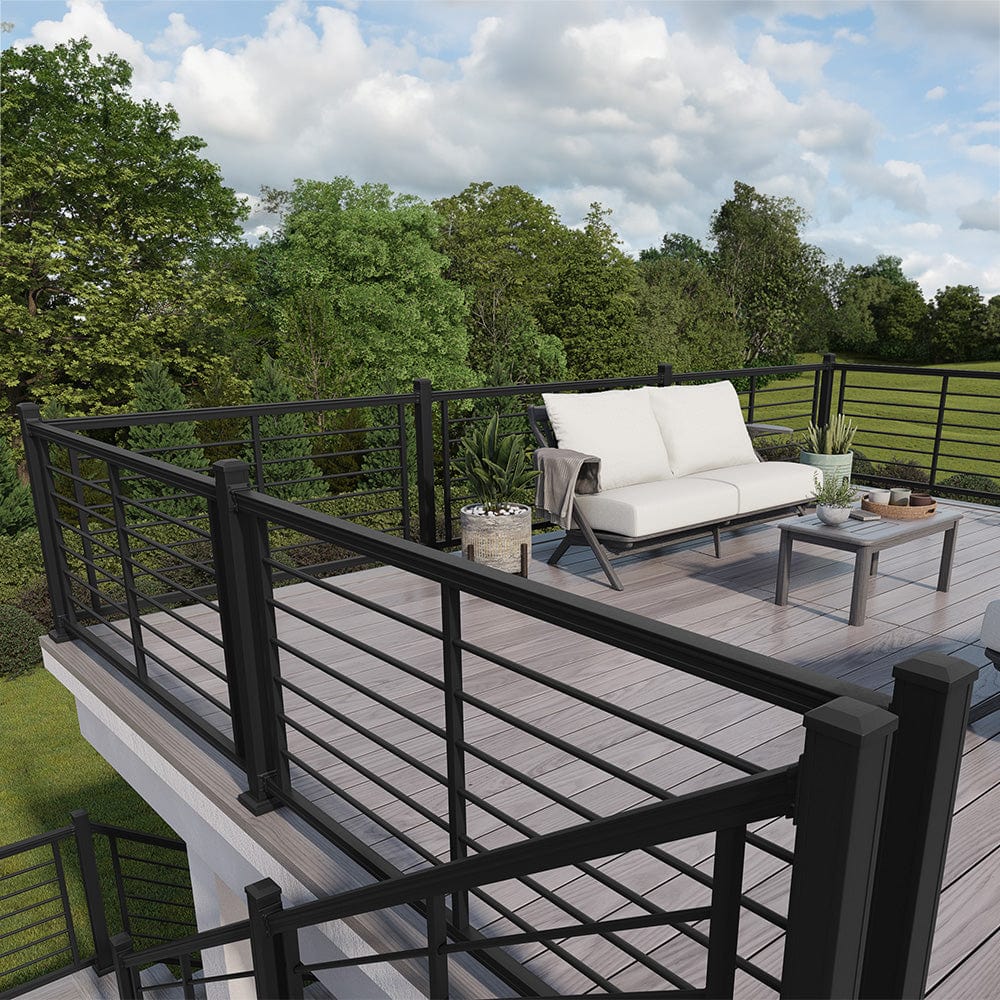
Stainless steel cables run horizontally between pre-drilled posts, creating an open, modern look with minimal visual obstruction. This is the most popular fascia mount style for decks with views. Keylink's horizontal cable system uses factory-drilled posts with 2-7/8" cable spacing that meets the 4-inch sphere rule right out of the box. The lock-jaw cable termination eliminates the need for crimping tools. Cable runs can span up to 100 feet without termination, the longest in the industry. Browse our full cable railing collection to see available options.

Square Baluster Railing

Vertical aluminum balusters between top and bottom rails offer a timeless, traditional look. Pre-assembled boxed sections arrive with balusters already attached to the rails, so installation is straightforward: cut to length, mount between posts. Keylink's 5/8" square balusters are available in the American, Chesapeake, and Outlook series, each with a slightly different rail profile. This is the most versatile and widely code-accepted infill option.

Vertical Cable Railing

Cables run vertically instead of horizontally, creating a look that blends the open feel of cable railing with the traditional orientation of balusters. Vertical cables resist climbing better than horizontal runs, making them a preferred choice for homes with small children. Keylink's vertical cable sections come factory pre-strung with stainless steel cables and support rods for structural rigidity.

Rod Rail

Horizontal aluminum rods replace cables for a similar sightline but with zero maintenance. Unlike stainless steel cable, aluminum rods do not require periodic tension adjustments. Rod rail works especially well in fascia mount applications because there is no cable tension pulling against the post connections over time.

All of these infill styles are available through our aluminum deck railing collection, with fascia-specific posts and brackets matched to each system.

Building Code Requirements for Fascia Mount Railing

The 2021 International Residential Code (IRC) introduced significant updates that directly affect fascia-mounted railing. Whether you are a homeowner planning a DIY project or a contractor pulling permits, these requirements apply.

When Is a Guard Required?

Per IRC R312.1.1, guards are mandatory on any walking surface more than 30 inches above the adjacent grade. This includes decks, balconies, porches, and landings. If your deck is 30 inches or less above grade, local codes may still require railing; check with your building department.

Height Requirements

Residential deck railing must be a minimum of 36 inches tall, measured from the deck surface to the top of the rail (IRC R312.1.2). Some states require 42 inches for residential, including California and parts of Oregon. Commercial applications (IBC) always require 42 inches. When fascia mounting, the railing height is still measured from the deck surface, not from the bracket. Fascia mount posts are manufactured taller to account for the below-deck bracket depth.

The 4-Inch Sphere Rule

No opening in the railing can allow a 4-inch sphere to pass through (IRC R312.1.3). For baluster systems, this means balusters spaced no more than 4 inches apart. For cable railing, cables are typically spaced at 2-7/8" to 3" to ensure compliance even with slight cable deflection between posts.

Load Requirements

Guards must withstand a 200-pound concentrated load applied at the top rail in both vertical and horizontal directions. Infill panels must resist 50 pounds per square foot. These loads apply regardless of mounting method, but they underscore why proper blocking matters for fascia mount installations. The post-to-rim joist connection must transfer these loads into the deck frame.

The 2021 IRC Continuous Load Path Rule

IRC R507.10.1 now requires a continuous load path from the guard to the deck framing. For fascia-mounted posts specifically, the joist receiving the post must be "connected to adjacent joists to prevent rotation." This means adding blocking between the rim joist and the nearest inboard joist at every post location. Connections relying only on fasteners in end grain withdrawal are explicitly prohibited under the updated code. This was the single biggest code change affecting fascia mount railing in the past decade.

For the full code text, see the ICC Digital Codes library (search IRC R312 and R507.10). The North American Deck and Railing Association (NADRA) also publishes helpful summaries of code updates for homeowners and contractors.

Is Your Deck Ready for Fascia Mount? A Structural Checklist

Before ordering fascia mount railing, walk your deck with this checklist. Catching structural issues now prevents costly surprises during installation.

Multi-family brick building with fascia mount aluminum railing on multiple balconies, demonstrating commercial-grade fascia mount installation

1. Confirm Your Rim Joist Is Structural

Fascia mount posts bolt into the rim joist (band board). This must be structural lumber, typically a 2x10 or 2x12. Some decks have a decorative 1x fascia board nailed over the structural framing. If your fascia is only 3/4" thick non-structural material, you will need to remove it or bolt through it into the structural member behind.

2. Check for Blocking

Look underneath your deck at each planned post location. There should be solid blocking between the rim joist and the nearest interior joist. If blocking is missing, it needs to be added before installation. The 2021 IRC requires this anti-rotation connection at every fascia-mounted post.

3. Measure the Deck Board Overhang

Deck boards often extend 3/4" to 1-1/4" past the fascia face. If the overhang exceeds 1/4", you will need to notch the deck boards at each post location so the post sits flush against the rim joist. Some manufacturers offer brackets with built-in standoffs to accommodate small overhangs.

4. Check for Obstructions

Gutters, downspouts, electrical conduit, and existing flashing can interfere with bracket placement. Walk the perimeter and note anything mounted to or running along the fascia face. You need roughly 6 inches of clear, flat fascia surface at each post location.

5. Assess the Rim Joist Condition

Probe the rim joist with an awl or screwdriver. If the wood is soft, spongy, or shows signs of rot, it cannot safely hold railing post loads. Repair or replace damaged framing before proceeding. Pay special attention to areas near the house where moisture tends to accumulate.

6. Verify the Fascia Height

Fascia mount brackets typically require a minimum of 6 inches of exposed fascia height below the deck surface. If your rim joist sits close to grade or is partially buried by landscaping, you may need to excavate or choose a different mounting method.

If your deck passes all six checks, it is a strong candidate for fascia mount railing. If you are unsure about any item on this list, consult a licensed contractor or structural engineer before purchasing materials.

Installation Overview and Common Mistakes

Fascia mount railing installation follows a logical sequence: install blocking, mount brackets, set posts, attach railing sections, and install infill. The process is more involved than surface mounting, but the result is worth the extra steps.

What to Expect

Plan for a two-person job. One person holds the post plumb while the other drills and fastens. Through-bolts (minimum 1/2" diameter, stainless steel or hot-dipped galvanized) are preferred over lag screws because they provide superior pullout resistance and let you verify the connection from the back side.

Keylink's fascia mount brackets feature a self-centering grooved design that automatically aligns the post during mounting, cutting alignment time significantly. You can pre-mount brackets to the fascia and then drop posts into them, which simplifies leveling.

Common Mistakes to Avoid

After 15 years of helping homeowners and contractors with railing projects, these are the mistakes I see most often with fascia mount installations:

Mounting to decorative fascia. The bracket must bolt into structural 2x framing. A 3/4" decorative board will not hold railing loads safely. Always confirm you are fastening into the actual rim joist.

Skipping the blocking. Without blocking between the rim joist and the nearest inboard joist, the rim joist can rotate outward under load. This is now a code violation under the 2021 IRC. Add solid blocking at every post location.

Using lag screws instead of through-bolts. Lag screws rely on thread grip in wood fibers, which weakens over time as wood expands and contracts. Through-bolts with washers and nuts on the back side provide a mechanical connection that maintains clamping force.

Ignoring deck board overhang. If boards extend past the fascia, the post cannot sit flat against the rim joist. Notch the boards at each post location or use spacers. Discovering this mid-installation wastes time and creates frustration.

Exceeding post spacing limits. Maximum post spacing varies by system and configuration. Going wider than the manufacturer's specified spacing voids the warranty and can compromise structural performance. Always follow manufacturer spacing tables.

Using incompatible hardware. Pressure-treated lumber contains copper compounds that corrode plain steel quickly. Use stainless steel or hot-dipped galvanized bolts, washers, and nuts. Electro-galvanized hardware is not sufficient for ground-contact or exterior framing connections.

Frequently Asked Questions

What is the difference between fascia mount and surface mount deck railing?

Fascia mount railing attaches posts to the side of the rim joist, keeping the deck surface clear. Surface mount bolts posts directly to the deck floor. Fascia mount recovers roughly half a square foot of deck space per linear foot of railing and avoids penetrating your waterproof membrane, but it requires structural blocking behind the rim joist. Surface mount is simpler to install and works well on concrete patios or budget projects.

Do I need blocking for fascia mount railing posts?

Yes. The 2021 IRC (R507.10.1) requires that joists receiving side-mounted posts be connected to adjacent joists to prevent rotation. In practice, this means adding solid blocking (typically the same dimensional lumber as your joists) between the rim joist and the nearest inboard joist at every post location. Without blocking, the rim joist can twist outward under load.

Is fascia mount railing stronger than surface mount?

When properly installed with adequate blocking and through-bolts, fascia mount is generally considered stronger. The sides of structural beams resist lateral forces more effectively than bolt connections through a deck surface. The critical factor is proper blocking and quality hardware, not the mounting method alone.

Can I install fascia mount railing on an existing deck?

Yes, as long as the rim joist is structural 2x lumber in sound condition and you can add blocking at each post location. Inspect the rim joist for rot, verify there is at least 6 inches of clear fascia height, and check for obstructions like gutters or flashing. Through-bolts are preferred for retrofits because you can verify the connection from the back side.

How far apart should fascia mount railing posts be spaced?

Spacing depends on the system and configuration. Always follow the railing manufacturer's specified spacing for your chosen infill type and post size. Exceeding it can void your warranty and may not pass code inspection.

Can I fascia mount railing if my deck boards have an overhang?

Yes, but you will need to address the overhang at each post location. If deck boards extend more than 1/4" past the fascia face, notch the boards so the post sits flush against the rim joist. Some bracket systems include built-in standoffs for small overhangs. If the overhang is extreme or if gutters block access, surface mount may be a better fit.

Ready to Start Your Fascia Mount Railing Project?

Tell us about your deck and we will help you choose the right posts, brackets, and infill style.

Get a Free Quote